
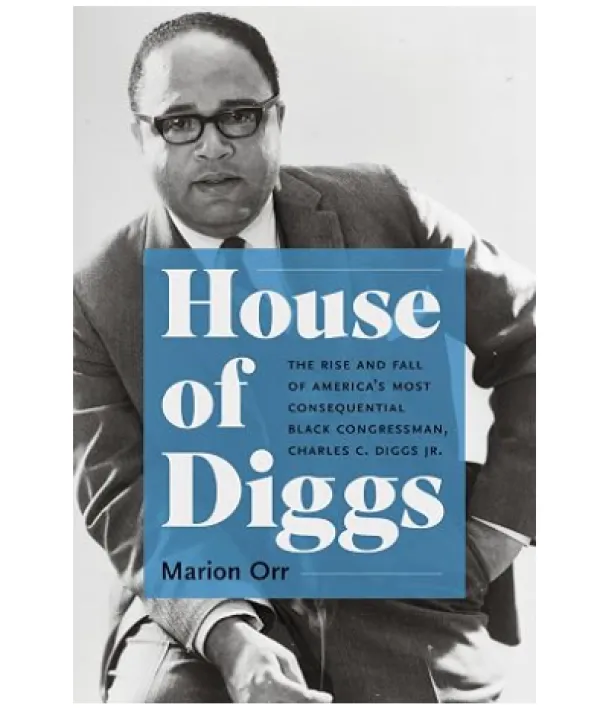
Book Review: House of Diggs - The Rise and Fall of America’s Most Consequential Black Congressman, Charles C. Diggs, Jr. - By Marion Orr
My introduction to Congressman Charles Diggs was through the 1987 PBS documentary Eyes on the Prize: America’s Civil Rights Years. He was interviewed about the kidnaping and murder of Emmet Till, a young black man, in Money, Mississippi, for allegedly whistling at and grabbing Carolyn Bryant, a white woman in a small country store where Till–a native northerner not privy to the ways of the Jim Crow South–and his cousins had gone to buy candy.
Diggs supported Mamie Till, Emmett’s mother and ensured that the local press kept the story alive. He also traveled to Sumner, Mississippi to observe the trial of Milam and Bryant, even as his own safety was threatened. Diggs protected Willie Reed, the young man who testified to hearing Till screaming in a shed located on the Milan family’s property, driving him to Memphis and getting him a flight to Chicago. Even though Diggs was a sitting congressman, Mississippi officials tried to bar him from the proceedings. They knew that as a federal official, he would shine a light on the virulent racism against blacks in Mississippi and the catastrophic failure of the criminal justice system in the Till case.
In hindsight, it seems as though the younger Diggs was destined for a life in politics and civil rights advocacy. His father, Charles Diggs, Sr., was born in Issaquena County in Mississippi – the most racist state in the United States – in 1894, two years before the United States Supreme Court gave the imprimatur to racial segregation in the case of Plessey v. Ferguson. The elder Diggs became one of millions of black southerners who migrated to the urban north in search of better lives.
In 1921 he opened the House of Diggs Funeral Home and helped found Detroit Memorial cemetery to ensure that blacks in Detroit could be buried in dignity. Diggs Sr. also became involved in politics. He joined the Democratic Party and worked diligently to convince blacks in Detroit to leave the Republican Party and follow his lead. In 1932 he became the first black Democrat to serve in the Michigan legislature and one of only two black state senators in the United States. Alas, Diggs Sr. lost his seat in 1944 following charges of bribery. His conviction, which his family thought was unjust, piqued his son’s interest in the law.
The younger Diggs grew up as part of the black elite in a tight knit black community. He attended the University of Michigan and the prejudice and discrimination he experienced there was instrumental in his decision to transfer to the historically black Fisk University in Nashville, Tennessee. Traveling to Fisk by train, he was forced to get off and move to a segregated car once the train reached below the Mason-Dixon line. Angry and humiliated, he never forgot the experience, and it was crucial in fueling his fight for racial equality.
In 1943 he was commissioned as a second lieutenant in the Army Air Corps. Even though he was an officer, he suffered the indignity of having white soldiers cross the street rather than salute him, and he watched German prisoners of war share meals with white soldiers and guards on trains and in restaurants that refused to serve black soldiers.
Known as Charley, the younger Diggs Diggs Jr. avenged his father’s political loss by winning that same seat in 1951 while he was still in his twenties. In 1954 he handily defeated the incumbent congressman and won election to the United States House of Representatives, becoming the first African American from Michigan elected to Congress.
By numerous accounts, Diggs was an effective, hard-working, and respected congressman. He built alliances and practiced what Orr caused “strategic moderation” while in Congress. He was a workhorse and quietly built coalitions with his colleagues, including a long friendship with his colleague and future president Gerald R. Ford.
In addition to his long advocacy for civil rights, Diggs led the successful campaign to have Frederick Douglass’s home designated as part of the National Park System; fought to improve conditions for American soldiers at home and abroad; was instrumental in the desegregation of the American air travel industry; fought doggedly for home rule for Washington, D.C.; and was a leading force in the development of the Congressional Black Caucus (CBC).
Diggs also led a year-long campaign that finally forced President Richard Nixon to recognize and meet with the organization. As chairman of the Foreign Affairs Committee’s Subcommittee on Africa in 1970, he held hearings to investigate why the government of South Africa refused to grant the black tennis star Arthur Ashe a visa to play in the South African Open. Along with Amiri Baraka and Richard Hatcher, the first black mayor of Gary, Indiana, Diggs co-chaired the National Black Political Convention in Gary in 1972.
Perhaps one of his most important achievements was how he encouraged the American government at the highest levels to reorient its relationship with the continent of Africa. He visited South Africa, Guinea-Bissau and Cape Verde and authored an Action Manifesto in 1971. According to Orr, “Diggs would make more official trips and fact-finding missions to Africa than any other member of Congress.” He was a vocal critic of how the United States government helped perpetuate apartheid in South Africa and supported armed struggle against it.
As consequential and important as his work was, his personal life was a mess and it would lead to his downfall. His father committed suicide in 1967 and Diggs became responsible for the family’s funeral business. His role as an elected official did not allow him to properly manage the funeral home and it struggled. In the late 1970s Diggs sold his interest in the funeral home.
He lacked discipline when it came to money, gambled, and lived well beyond his means. He was an inveterate womanizer and married four times, which caused severe financial hardship. He began using money from his congressional office and employees to pay his personal expenses. A confidential informant reported payroll violations to the United States Department of Justice. In March 1978 he was indicted on twenty-nine felony counts by a federal grand jury and subsequently convicted the following October. Diggs maintained his innocence and was re-elected while awaiting sentencing. He was stripped of his committee chairmanships in 1979. Freshman congressman Newt Gingrich (R-GA) held up Diggs as a perfect example of corruption by the Democratic Party and led the charge for his expulsion from Congress. The House Representatives voted 414-0 to censure Diggs on July 31, 1979. Diggs resigned from Congress in June 1980. He was subsequently sentenced to three years in prison and served fourteen months.
After his release from prison, Diggs enrolled at Howard University and earned a bachelor’s degree in political science. He also returned to working as a mortician and served as a consultant to the Congressional Black Caucus. He attempted to return to politics, running unsuccessful campaigns for Wayne County (Michigan) Commissioner and a seat in the Maryland House of Delegates. He died from complications of a stroke in August 1998.
House of Diggs is a gracefully written and worthy biography of an important and often overlooked figure in the annals of American public life.